
| « Preventing Natural Disasters Demands Effective Architecture | Call to Action to Stem the Mounting Federal Debt » |
Memo to Congress: Invest More in Private Spaceships
09/16/10
I am respectfully questioning the economic intelligence of the commercial spaceflight investment strategies being designed and advocated by the U.S. House of Representatives Science and Technology Committee.
I was reading a report in the New York Times about Boeing’s plans to fly tourists to space, and learned that the House Science and Technology Committee was effectively pushing an agenda that would frustrate Boeing from realizing these plans. While NASA and the Obama Administration requested in their 2011 budget about $6 billion over five years to invest in private companies, Chairman Bart Gordon of the House Committee would rather see NASA keep their traditional spaceflight portfolio, by investing only $0.9 billion in the same period.
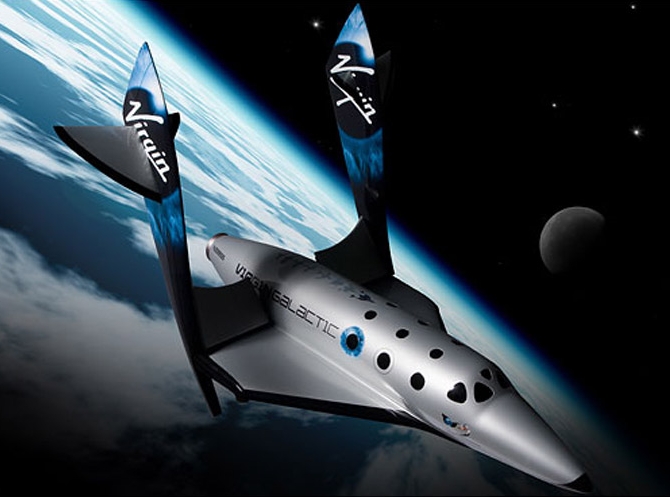
'Space Ship Two' by Virgin Galactic, product of billionaire entrepreneur Richard Branson
This stimulated me to go to the Committee’s website, http://science.house.gov/, and click on their NASA keyword link, to consider their reasoning. Their most recent publication is a letter addressed to Stanford University Professor Scott Hubbard by Chairman Gordon. It turns out that Professor Hubbard of Stanford's School of Engineering is as much of an expert on these matters as anyone on the planet (here is his bio). Apparently, one of Professor Hubbard's main concerns expressed to this House Committee was the public need to better support commercial spaceflight investment.
Follow up:
Here is Chairman Gordon's response to that concern: “...it is premature to make NASA's human space flight plans dependent on the achievement of the significantly more difficult objective of developing commercial crew by a date-certain and for an assumed cost.”
The sad part about this excerpt is that it suggests a fundamental distrust by Chairman Gordon about the innovation-based economic return on private investments. It seems that Rep. Gordon's show-stopping concern is that NASA was unable to prove that the companies it would count on could provide "certainty" regarding their cost in time and money to satisfy project deliverables. His skepticism of NASA's and the Obama Administration's economic calculus is reflected in a June 17, 2010, report by the same author as the Times article referenced above (Mr. Kenneth Chang, Panel Demands NASA Documents to Support Budget).
It is ironic that Representative Gordon fails to mention NASA's embarrassing overall record on budgets and time-lines: a February 2010 study by the Governmental Accountability Office (GAO) found that of 13 missions for which NASA provided figures, a total of 10 were delayed by, on average, 11 months and cost 13% above the original estimates.
I think Committee Chairman Bart Gordon must stop holding the incredibly potent future of a private spaceship industry hostage to his need to micromanage every facet of large-scale economic development. No project, whether in a public or private sphere, is certain. But supporting free enterprise in the United States—i.e., high-stakes competition among world-class companies like Boeing and Virgin Galactic—is really the best means for multiplying and diversifying return on our public investments. Specifically, these companies become incentivized to spend their own private capital in addition to ours, and use their own industrial expertise in collaboration with NASA’s, to ensure the greatest possible success of their projects. And because they are deeply motivated to maximize profit, some will surely find ways to use our investments to break open new niche markets. Relevantly, I recall quoting in a previous publication the multi-billion dollar technology investor John Doerr as saying: "Congress can't model innovation".
Alternatively, NASA's existing manned spaceflight plans are technologically decadent, by multiple measures and perspectives. A report lead by former Lockheed Martin chief executive Norman R. Augustine, titled “Seeking a Human Spaceflight Program Worthy of a Great Nation”, concluded that existing plans to build a moon base were “not executable” because of its debilitating price tag. I think that NASA, like every other U.S. department or institution, can only afford to be cutting costs in the decades that follow, in order to slash a scary Federal deficit—and seize global economic opportunities, which did not exist when John F. Kennedy pointed his finger to the moon half a century ago.
Shame on our U.S. Representative Bart Gordon and the House Science and Technology Committee for not fundamentally trusting in American free enterprise as the most efficient engine for driving public welfare. It is fair for Representative Gordon to consider the extent that the commercial crew and cargo industry is "mature" enough to function reliably in the short-term, but it is arrogant for him to assume that he is any expert of the industry's technological capacities for exponential growth over long time-scales, which are what really matter. He and "many in Congress" believe they are being well-advised, despite what the majority of leading engineers, entrepreneurs, and economists in this area predict with a green light from his committee. It follows that I do not believe his actions are fair to Americans and peoples worldwide, because they stifle the inevitable emergence of a thriving spaceship industry... There is an exciting vision that American entrepreneurs today are ready to begin realizing, and so our planned-economy people in Washington need to kindly step aside, and plan for these entrepreneurs to start building Star Trek spaceships for Planet Earth.
No feedback yet
Comments are closed for this post.
Through researched policy publications and targeted public services, we help equip and motivate lasting improvements in society.
More about us »