
| « Clean Energy: When & How? | Engaging Iran: Analysis » |
A Different Take on Space Research
10/28/09
I learned through a TED talk about the Ansari X-Prize, a $10 million prize awarded five years ago. To win the prize, teams had to create a vehicle capable of sending three passengers to a height of 100 km, twice within a two week period. Twenty-six teams from seven nations entered, and collectively spent over $100 million. The winning entry, SpaceShipOne, was put in the Smithsonian National Air and Space Museum. The prize sparked the beginning of the private spaceflight industry, and since it was awarded in 2004, over $1 billion has been spent on private spaceflight.
Although the $10 million was difficult to raise, it pales in comparison to NASA's budget, which is well in excess of $17 billion, and may exceed $18 billion in the next few years.
Public vs. Private: (left) NASA's Endeavour launches; (right) SpaceShipOne in flight
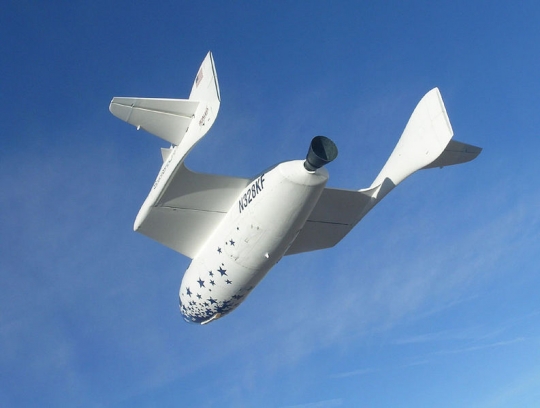
Images courtesy of NASA and Scaled Composites, LLC
Personally, I have never been a fan of complete government control over the space industry, but I understand why many people are. From a military standpoint, having corporations in control of space rather than the government is risky and could be disastrous. From a legal standpoint, having corporations stake out parts of space (or equity on the moon, as the TED speaker jokes about) is unprecedented and messy. Privatization of space would cause a lot of work for a lot of bureaucrats, and a plethora of new legal issues.
But I am still forced to wonder, if so much was accomplished with only $10 million, what could be done with just one tenth of NASA's budget?
Follow up:
Privatization would be a risk, of course. However--if it is regulated properly--I feel that the sheer potential for growth vastly outweighs the risks involved.
I suggest that the government begins taking a limited role, offering prizes modeled after the X-Prize, and letting capitalism handle the rest. I am not proposing dissolving NASA, immediately privatizing the industry, or making any other severe, rash decisions. I am simply proposing an experiment. NASA has had over fifty years to establish an efficient model for space exploration. Now, it's time to allow for some competition.
1 comment
Any aerospace follower would note that the most viable candidates in the competition spent well OVER $10 million dollars in development of their space craft. Scaled Composites alone, spent $25 million to develop SpaceShipOne (all funded by Paul Allen). Sure, there should be private industries involved in space exploration, but this is just a poor argument! If anything, those competing for the $10 million prize were more after bragging rights in the history books, than the money which would not have come close to covering their developmental costs.
And to make the argument that NASA isn't taking part just shows poor research. Just 7 days ago, on Nov. 5, the X PRIZE Foundation along with NASA awarded $2 million (funded by NASA) to Masten Space Systems and Armadillo Aerospace. This is the largest X-Prize payout since the Ansari X-Prize.
Capitalism ALREADY IS handling the rest, as the author suggests. Space tourism and exploration is currently a highly developing sector. Commercial Space Ports are being built, space flights are being booked, and space hotels are being planned and developed. Even the government's Augustine Panel on Human Space Flight has suggested that private industry take a larger role in the future of space flight - taking on missions to deliver cargo to the International Space Station.
I expected much better reporting from a this think tank, and an rather saddened to see such a poorly researched post by an out-of-field author who clearly has a chip against NASA and the government. While his intentions are good, and his vision admirable, the errors and misinformation only detract from his message and the image of The Dynamo.
Comments are closed for this post.
Through researched policy publications and targeted public services, we help equip and motivate lasting improvements in society.
More about us »