
| « A Different Take on Space Research | Architecture and Climate Change: Building Sustainably » |
Engaging Iran: Analysis
10/04/09
To read the MLA formatted version as a PDF, click here.
Whether Iranian President Mahmoud Ahmadinejad was democratically elected or divinely selected, his rule must be respected.
Rhetoric from Iran has been alarming. Israel understandably fears being attacked, based on Mahmoud Ahmadinejad's talk in 2005 about "wiping the state of Israel off the map". This fear has nurtured a hawkish philosophy of pre-emptive invasion, "if necessary", by many Israeli and Republican leaders.
Indeed, the Iranians have kept secrets about their nuclear program—evidenced by the recent revelation of an undisclosed uranium-enrichment site, outside the holy city of Qom. Furthermore, it seems clear that Iran has the technical data to make a nuclear bomb, while Iranian leaders claim otherwise.
But Iran seriously attacking Israel is suicide: Israel is guaranteed by a nuclear West. Considered in this context, the threat of a nuclear Iran seems purely economical. Since China and Russia are major partners with Iran, a war with Iran would be self-defeating for everyone. Iran knows this, and so is willing to take "unreasonable" risks, forcing the international community to compromise.
While this makes sense, Iran's motives are not clear to the public. This is why negotiations between Iran and the U.N. Security Council on Oct. 1st, 2009 were especially important. This was the first substantive high-level discussions with Iran that included the U.S. in decades. And it produced real results: Iran has agreed to have Qom inspected on Oct. 25th, and interestingly, Iran has agreed to export its low-enriched uranium for processing in Russia and France. In the short run, this means that it will take Iran longer to build a nuclear weapon.
Gauging Iran: President Obama has warily lead diplomatic engagement with Iran
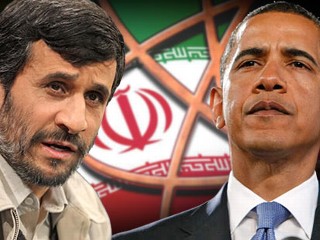
Image Courtesy of ABC News
What does this mean in the long-run? The wise analysis is that it is too soon to tell; Iranians could be playing for time. My understanding is that Iran must be approaching this multilaterally: it is clearly in Iran’s benefit to have the economic leverage of a nuclear weapon – but not to be destroyed by this incentive. Iran, resting on large Russian and Chinese assets, will milk as much benefit from their advances as possible, without crossing the line that Iraq did. That is why the West must articulate this line clearly for all.
Follow up:
Carlos Pascual and Steven Pifer of Brookings assert there is little doubt that if Iran acquires a nuclear weapon, then "others in the region will follow suit". Analysts fear a scenario where Iran "breaks the seal" of nuclear weapons policy, undermining global governance measures like the Nuclear Non-proliferation Treaty—thus increasing chances of catastrophe.
And so we must work with Iran, for mutual security and prosperity—because their failure is also ours, in this twisted global economy—but we cannot allow Iran to cause a security meltdown.
So in the short term, future negotiations must be consistent and pertinent. Iranian leaders must understand what Mr. Obama's rhetoric of "our patience is not unlimited" means: the international community will not idly watch Iran advance a cleverly-hedged nuclear-weapon initiative that could topple a secure non-proliferation regime; it means that even China and Russia would be willing to impose more severe (albeit possibly ineffective) economic sanctions on Iran, if Iran's leaders still lack Western support as their deadline approaches: a function of how long the Western intelligence-community thinks it would take Iran to build a nuclear weapon. Now, China and Russia have more to risk by souring ties with the West than by absorbing losses in Iran. So Mr. Obama’s rhetoric must also mean that if said sanctions are ineffective, while Iran’s nuclear program remains under global suspicion, then a military wake-up call legitimately remains "on the table", out of necessity.
Iran knows all of this well. Yet their leaders will stay the course, unless an international community that strongly includes Russia and China has firm, grave ultimatums. Thus, the key to engagement with Iran is actually to focus on unifying a multilateral global front, with Russia and China as strong players. Only then would we truly see Iran respond to larger carrots and sticks. Doing this would require tangible economic compromises by the West for Russia and China… But if the West is willing to make these compromises, then so too will Russia and China, and then Iran will be forced to provide substantial evidence of its accordance with international law over the following months, through reconciliations or proof.
But expect tensions to increase, before they dissipate: Iranians have a history of noncompliance with Western initiatives. Further, China and Russia are not yet incentivized enough to viscerally safeguard the non-proliferation regime. Yet, know that all of this friction can suddenly disappear, liquidating a rush of economic posturing toward secure and peaceful collaboration from all parties – in response to the approach of otherwise ominous deadlines, and genuine offers of engagement.
No feedback yet
Comments are closed for this post.
Through researched policy publications and targeted public services, we help equip and motivate lasting improvements in society.
More about us »