
| « Outsourcing: Different Debates in the US and Europe | Preventing Natural Disasters Demands Effective Architecture » |
The Future of Smart Computing Systems
02/23/11
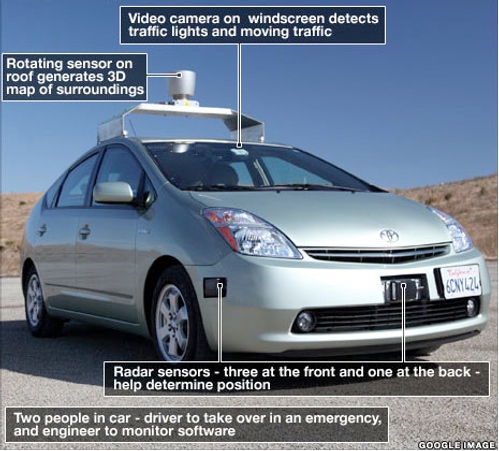
Google has test-driven an auto-piloted vehicle over one thousand miles.
PEOPLE are using information technologies today in more ways than anyone fully understands. The number of Internet devices in 1984 was one thousand; in 1992, one million; and in 2008, one billion. Consensus is emerging that there will be around 50 billion Internet devices in 2020. Forrester Research forecasts that over the next 6 years, spending by US government and businesses on "smart computing technologies" will increase from about $40 billion today to over $400 billion. Xinhua News Agency, speaking on behalf of China's government policy, announced $601 billion in investments planned over the next decade to deploy smart grid systems across its mega-cities. Other countries are following suit in the race for economic modernization.
This modernization is the popular adoption of smart computing systems: physically-intelligent electronics, which can sense environments in various ways, and dynamically interact through communications and control machinery. These intelligent systems are very likely to bring the next wave of societal evolution by disrupting a majority of industries and professions. Computing will become ubiquitous at home and work, in public spaces and surprising places. Widespread mechatronics will make smarter buildings, transportation systems, power systems, "phones", and pharmaceuticals. Artificial intelligence will play an increasingly large role in business, government, military, and academic innovations, percolating throughout the global economic infrastructure. The Economist predicts that smart systems “may well be humankind’s best hope for dealing with… global warming.”
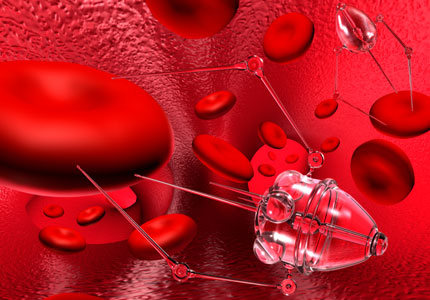
Biomedical engineers today are learning how nanobots could become common in health care
Smart computing systems should be doing revolutionary things over the next decade:
- Helping 25% of all new US buildings optimize home energy networks and people's happiness
- Safely driving millions of people, millions of miles, 99.9999% of the time
- Advising high-level thinking, coordination, and action of millions who will use dynamic mobile apps
Smart systems will exponentially increase government performance while reducing government costs – something that Congressional Budget Office projections are probably not counting on right now. (I once reported John Doerr as saying, "Congress can't model innovation.") Human-computer interaction will slowly revolutionize education: the lines between Nintendo games and educational software will blur. Personalized mechatronics – adaptions of PCs – will connect with people using diverse wireless sensor networks, delivering opportunities for global telepresence. The privileged will be able to control almost anything, anywhere, with minimal conscious demands. These applications will be vigorously brought to mainstream industries and markets, and the future of economies will begin to directly track evolution of underlying smart technologies.
Smart computing systems will ultimately advance the limits of our biological existence. Software-driven pharmaceuticals may quickly become widespread treatment by MDs as regulation is modernized and technologies converge. Automated biomedical applications, like artificial hearts and ubiquitous organ monitoring, will be adopted by thousands in this decade. Market developments for most smart medical systems will lag more than 5 years behind advances in the underlying smart technologies, since biotechnologies require extensive scientific research and product testing. Some people believe the technologies that do successfully penetrate the market will end the cycle of life and death by 2050. There are good scientific reasons to doubt that we will all become immortal cyborgs - but young people who are ambitious and lucky could feasibly live double the average lifespan.
Indeed, it would be science-fiction to ignore the roadblocks facing innovators today. So mainstream deployment of many breakthrough smart systems, especially those based upon biotechnologies, will end up being beyond a few decades. Talent gaps across disciplinary lines will amplify the challenges to systems engineering; public policy, regulatory, and law regimes will be blasts from the past; millions of people will organize to resist change; and long, expensive, and unusually risky product development lifecycles will scare away investment. While Wall Street is neglecting this nascent multi-trillion dollar market, visionary venture capital firms, like Kleiner Perkins and Foundry Group, are trying to catalyze the ability of entrepreneurs to build equity from the complex research portfolios of NSF, NIH, and the like.
But not everyone will gain equally from smart systems. Many professionals will see their skill-set supplanted in cost-effectiveness and performance, as automated systems threaten to "hollow out" the middle class. For example, legal analysis, which society has exchanged billions of dollars over, is being outsourced to Watson-like software that can scan documents and computationally deduce high-level patterns – much faster and cheaper than humans. For every major problem, a smart system will be developed. Educational and training institutions should reform their curricula accordingly to reflect the changing jobs outlook.
Smart systems will drive radical socioeconomic changes that few people even thought possible. Capabilities of value extraction from existing resources will be exponentially increased. Humanity will evolve on individual and collective levels through these cyber-physical systems.
--
Lance Legel is a Digital Energy Fellow in the Interdisciplinary Telecommunications Program at the University of Colorado Boulder. He hopes to deploy smart systems in the years to come.
Feedback awaiting moderation
This post has 41 feedbacks awaiting moderation...
Comments are closed for this post.
Through researched policy publications and targeted public services, we help equip and motivate lasting improvements in society.
More about us »