
| « Improving Energy Efficiency Through Smart Grid Networks | Clean Energy: When & How? » |
Eight Years In: An Examination of the Problems in Afghanistan and Potential Solutions to Fix Them
11/12/09
One of the premier foreign policy issues that faces the United States today is the conflict in Afghanistan. Months after inheriting this eight year old war, President Barack Obama has yet to determine a strategy that either supplements or diverges from the directives of the previous administration, despite the evolving and deteriorating nature of the conflict.
Several points have made the formation and implementation of policy to this situation slow to develop. Among these are the troubles with the recent Afghan presidential elections, the resurgent violence of the Taliban and Al-Qaeda movements in different regions of Afghanistan, the consequent gap of opinion between the American public and American political and military advisors on how to stymie that resurgence, the re-examined national security value of the conflict to the United States (in light of emerging quandaries with Pakistan and Iran), and the desire of the Obama administration to distance itself from the image of hasty decision-making processes characteristic of Mr. Bush and his staff. Understanding these problems is the first step in articulating the most correct route to pursue in regard to Afghanistan.
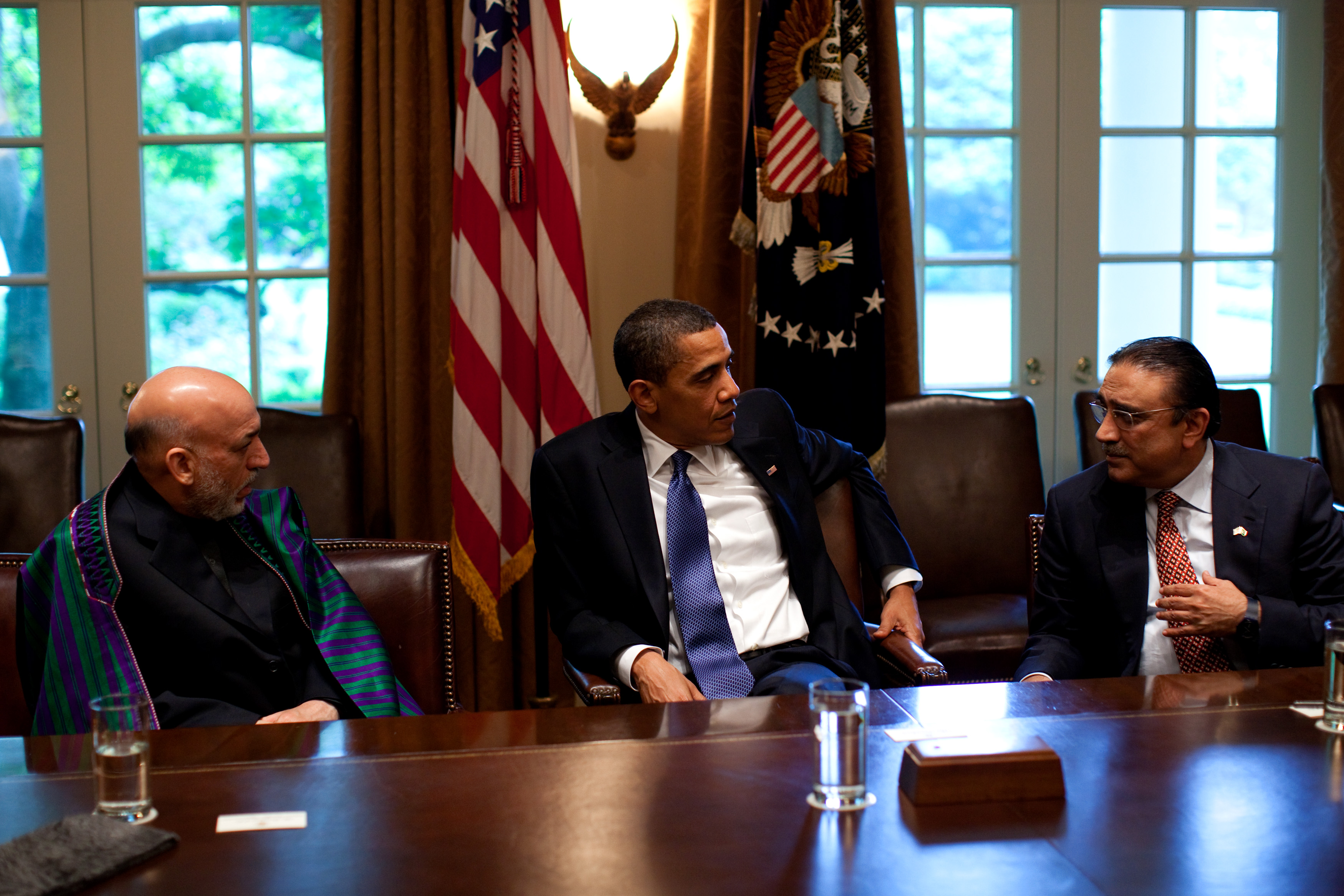
Trilateral Meeting: (left to right) Presidents Hamid Karzai of Afghanistan, Barack Obama of the U.S., and Asif Ali Zardari of Pakistan confer on policy
The first issue mentioned above is certainly the most visible: the fraud-spattered elections in August 2009. The two major opponents in this election were incumbent-President Hamid Karzai and Dr. Abdullah Abdullah. The results, which produced a decisive victory for Karzai , were immediately disputed. After UN intervention, cautious US condemnation, and the promise of a run-off, Abdullah rescinded his election bid (with ominous rhetoric) on November 1, 2009, less than one week before the scheduled run-off election. This issue underscored two very serious problems with the legitimacy of the Afghan government: the first one, being causal, is the deep-seated corruption on various levels of the Afghani political structure; the second, being partially reactionary, is the budding distrust of the government by the Afghan public, a condition which invites a whole domain of other problems.
The second major obstacle that stands in the way of articulating a comprehensive plan of action is the reemerging violence that has been cropping up in Afghanistan. Reported early in 2009, the amount of violent incidents rose over 31% between 2007 and 2008, bringing a “new peak of intensity” to conflicts. Although this is linked in part to the recent push into areas previously not penetrated by military forces, it still underscores the fact that large pockets of violent resistance still exist throughout Afghanistan. The growth in tactical advances (like the growing use of remotely controlled explosives and the increased targeting of officials by the insurgents) shows a growth in the sophistication of emerging conflict and points to the Taliban as the force propagating this violence. Without any doubt, the human cost of staying in Afghanistan to the US Military has been consistently rising since the inception of the conflict. This, in conjunction with an exponential increase in international troop fatalities and the devastating loss of civilians, has shed perspective on the increasingly costly and bloody nature of the conflict in Afghanistan.
Following the Iraq example, many advisors to and within the Obama administration have responded to this obstacle by suggesting a step up in troops to combat this resurgence. The calling for an increase of “boots on the ground” has seen most of its political backing from Republicans in Congress and the military establishment via the current Joint Chiefs of Staff and NATO Commanders. Democrats remain widely resistant to the idea of a troop increase, including outspoken members of Obama’s own cabinet like Joe Biden and Rahm Emmanuel. Mr. Biden cites several objections, from the political cost of increased engagement on already war-weary Americans, to the questionable necessity of the escalation considering the amount of troops already deployed there (68,000) and the growing ability of Afghan forces to tackle these issues. Mr. Biden seems to be correct in his understanding of public sentiment, as very recent polls suggest a majority of Americans are against any troop increase. This divergence in perspective between the right, the military establishment, and some members of his cabinet and the left, the public, and some other members of his cabinet, has very likely fueled the inability to actuate any meaningful new strategy.
Another key consideration to weigh is the necessity of success in Afghanistan and its strategic importance to US National Security. Although the amount of debate on what to do in Afghanistan has seemingly concreted the notion that we ought to be there, some attention has been paid recently to the argument that Afghanistan is of no vital importance whatsoever, and moreover that continued military presence there is unnecessary, or at least a secondary concern to other more immediate qualms. Officials cite that eliminating Al-Qaeda is the central goal of activity in Afghanistan; however, Al-Qaeda has largely migrated across the border to Pakistan, where tension and conflict is escalating dramatically. Joe Biden has a similar stance, expressing his desire to focus more primarily on Pakistan. Growing tension with Iran (a much more stable nation with stronger anti-American sentiment and a developing nuclear capability) also seems a bit more significant in national security terms. However, others point to the strategic importance of a creating and maintaining a stable Afghanistan in order to effectively promote the broader welfare of the region. Pakistani ex-Presdient Musharraf has expressed similar notions, stating plainly that pulling out of Afghanistan now would be “disastrous”, as it would permit Taliban and Al-Qaeda forces to regroup against regional governments and the US.
Taking all of that into mind, an effective strategy can now be more reasonably developed. Knowing that there exists a necessity in Afghanistan for a legitimate and unified government allows for us to assert that one of the primary responsibilities of US involvement is to develop an institution that is able to confront the challenges that currently exist and will presumably manifest and is backed by the people. To achieve this, the first step has to be ardent corruption reform, led either by US or UN diplomatic forces, as currently most Afghanis view the Karzai government as corrupt. This goal can be realized through strictly overseen elections (by the US/UN diplomatic force), strong counternarcotics measures (like those described by the Brookings Institute) that would simultaneously decrease funding drug lords provide to insurgency groups while alleviating suffering on the public that is propagated by the drug lords and their insurgent allies, and a commitment to education by the Afghan government (both for children to provide for a more apt Afghani populace, and for adults, to pro vide for a more informed Afghan electorate). Overall, these measures alone would indirectly provide against insurgent violence and help to sustain the Afghan state.
Directly addressing the violence is a more problematic issue. Lending from historical examples, a combat troop increase would appear to be unwise on several levels. First and foremost, American public sentiment is not behind an escalation right now and without tremendous emphasis from the Obama Administration or an Afghan-linked security threat, it is unlikely it will be. This is a significant political factor for a first term President, with midterm elections only a year off and his personal re-election bid to consider. Second, there is a lot of argument on the tactical effectiveness more troops would garner. In unconventional, ideological-based conflict, where the enemy is well-hidden among the general public, traditional armed forces are not as capable of eradicating the enemy. This makes the case for more troops seem irrelevant (you can’t fight an ideology and a hidden enemy with just violence). This notion has historical grounding, as seen in the 1965 Operation Rolling Thunder example, where increasing military pressure on an ideological, guerilla foe (similar to the insurgents in Afghanistan) ultimately lead to a broader mobilization of their efforts, or more plainly, dramatic increases of force by the US could breed dramatic increases of counter-force. This in turn provides another problem with troop increases: escalation in troop levels set credibility traps. Taking from the Vietnam example, the more invested we were in troops and resources, the more committed we had to be in resolve in rhetoric (for the international credibility of our military and for justification to the American public); this would be the same in Afghanistan. Escalation then creates something of a Catch-22 style conundrum in that if immediate success is not attained, leaders would presumably have to keep escalating levels until it becomes a war of attrition, which judging by current American political sentiment, would not be a prudent path to pursue.
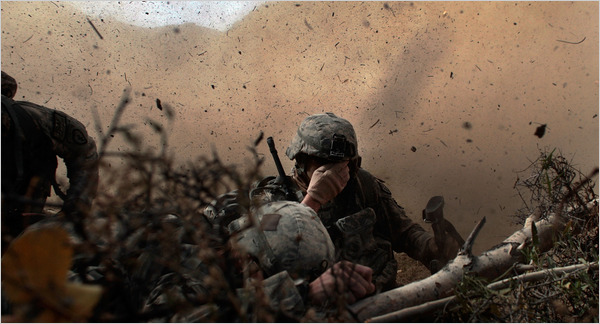
*image courtesy NY Times
What can be considered instead is a recalibration of forces in Afghanistan to include a much heavier emphasis on diplomatic presence (with officials from the US and the UN) and a more limited, and gradually scaled-down, amount of combat personnel (who will be mostly focused on training Afghan security forces). Diplomatic forces could help ensure the corruption reform mentioned above, help to democratize and educate the people (or assist and oversee the Afghani government’s action in this direction) and provide advisement to the nascent Afghani political establishment. After measurable corruption reform occurs, the role of combat personnel could shift very predominantly to the training of Afghan security forces. It is important to stress the necessity of corruption reform being implemented beforehand, as it would be sincerely unwise to develop armed forces for a corrupt and potentially despotic government, both in human rights and geostrategic terms. As more security forces are trained, American and international combat troop levels could significantly decrease and they should as to add more pressure and responsibility to the Afghani government in dealing with their own internal conflicts.
In addition to reforming our presence there, US and international diplomats should work to foster a coalition with Afghani and Pakistani governments to work against their shared enemies. Although the coordination of military action might be unfeasible, it is very imaginable to have broad intelligence sharing. Working together and in conjunction with what foreign troops will still be there, this could very strongly provide against insurgents who hop between the Afghanistan and Pakistan borders and promote lasting relations between to geographically close and ideologically similar nations. This could be aided and facilitated by maintaining a residual reactionary force of NATO troops, which would stimulate cohesiveness and a sense of security in the region. The length of time those troops would have to stay there would be purely conditional on the amount of time it takes for the region to reform, and it would be reasonable to assume that this could be many years.
Accumulatively, although Afghanistan has a wealth of internal problems, through intelligent and focused measures progress can and will be made. It is crucial that the government in Afghanistan is substantiated and legitimized by the people. As history shows us in the early years of US dealings with South Vietnam it was very clear how unpopular and vicious the “stable” government was. The continued support of the South Vietnamese regime by the US only added to the anti-American sentiment among the population there and the consequent fueling of insurgent efforts. Likewise, as seen in Iran in 1979 , people tend to act out against tyrannical leaders, especially those who seem to be propped up by a foreign hand. If the Karzai government appears to be just a US puppet-show that offers no benefit to the people, it will eventually be rebuked. So, through a recalibration of forces, a commitment to corruption reform (which Karzai has promised) and by maintaining a residual reactionary force real progress will be seen in Afghanistan.
*special thanks to W Blake Cook for his assistance in the formation of a potential Afghanistan strategy
1 comment
Comments are closed for this post.
Through researched policy publications and targeted public services, we help equip and motivate lasting improvements in society.
More about us »