
| « Women & Wars: A Conversation with Dr. Laura Sjoberg | C.I.A. Crisis Simulation Highlights Challenges to Intelligence Analysis » |
Transgressions in East Jerusalem
03/25/10
Following the 1967 Arab-Israeli War, Israel has controlled several territories (specifically the West Bank, East Jerusalem and the Gaza Strip) which contain predominantly Arab-Palestinian populations. Israel has kept control of these areas often through the use of violent and disproportionately reactionary, military means and has increased Jewish settlements within them (particularly in East Jerusalem) over time, in an attempt to create a Greater Israel (an Israeli state that permanently includes the West Bank and Gaza Strip) with Jerusalem as its internationally-recognized capitol.
Continuing on that path, current Israeli Prime Minister Benjamin Netanyahu's government coalition announced recently, on the very day that American Vice President Joe Biden was visiting Israel earlier this March, that 1600 new homes will go up for Jewish settlers in East Jerusalem - again, a largely Palestinian-inhabited territory. Outrage flared as new Jewish settlements into East Jerusalem have already displaced Palestinian families and lead to the abrupt bulldozing of homes and property. Netanyahu's announcement comes right after Palestinian leaders agreed to indirect peace talks, after a 14-month hiatus, and will surely derail any chances of negotiation.
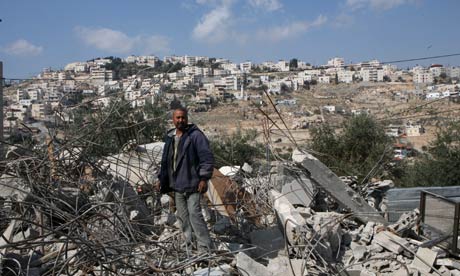
40-year-old Palestinian Mahmoud al-Abbasi stands amid the rubble of his home after it was demolished by the Jerusalem municipality in the East Jerusalem neighborhood of Silwan. Image courtesy of The Guardian UK/Gali Tibbon
Follow up:
The world community, including President Barack Obama, British officials, the UN Secretariat General Ban Ki-moon, and leaders within the European Union quickly condemned this action, viewing it as detrimental to the ever-ongoing Middle East peace process and as another step into what is widely considered illegally-held territory. Secretary of State Hillary Clinton labeled this preemptive, unilateral action (particularly the timing of the announcement) as "insulting".
However, speaking recently to AIPAC (the American Israeli Public Affairs Committee - a powerful pro-Israel lobbyist group in Washington, D.C.), Israeli Prime Minister Netanyahu clearly extolled his belief that, "Jerusalem is not a settlement," saying further that, "The Jewish people were building Jerusalem 3,000 years ago and the Jewish people are building Jerusalem today. It's our capital" [emphasis added].
However, Netanyahu's rhetoric runs widely against international calls for the cessation of Jewish settlements into already occupied East Jerusalem and West Bank communities and for Jerusalem to be a "shared capital" between Israeli Jews and Arab Palestinians.
A senior Hamas official and deputy politburo chief, Mussa Abu Marzuk, called for a united Palestinian uprising in response to the announced settlements, saying "Every Palestinian should rise up ... against the forces of the (Israeli) occupation." Two uprisings, or "infitadas", have occurred in Israel since the 1967 seizure of the West Bank and Gaza strip- one in 1987 and one in 2000. Secretary Ban Ki-moon however urged restraint on both sides, pushing again for renewed, peaceful negotiations.
Dr. John Mearsheimer, professor of Political Science at the University of Chicago, as well as author of the New York Times Best Seller, "The Israel Lobby and US Foreign Policy" recently spoke at the University of Florida where he explained the United States' ongoing role in relation to Israel. Dr. Mearsheimer offers a similar solution to what much of the world has called for in regard to Israeli-Palestinian tensions- the formation of a "viable Palestinian state". He contends that the increasingly problematic holding of the West Bank and Gaza Strip, through generally oppressive and undemocratic means, will eventually make Greater Israel an "apartheid state", at which point relations between Israel and the US, as well as Israel and the rest of the world, will become increasingly strained and unsustainable. He sees this as an unfavorable outcome for all three parties directly involved: the US, Israel and Palestinian Nationals. Mearsheimer also believes that any imperious action taken by Israel into Palestinian territory, while denying proportionate representation to the self-identifying 3.8 million Palestinian nationals residing in those territories, is an irrational path for Israel to follow, for the sake of its continued security. Moreover, he feels that the US is not fulfilling its potential as a mediator in this ongoing conflict, by not applying appropriate pressure (via sanctions or withholding US Foreign Aid, which Israel is heavily dependent on) to Israel to act in more suitable ways. Mearsheimer contends these misguided policy maneuvers in the US are largely the result of the very powerful "Israel lobby", which consists of AIPAC, in addition to "Christian Zionists" and neoconservatives, who heavily influence foreign policy making in Washington, D.C., and have for years.
Despite international condemnation of these actions however, it appears that Israel will continue to pursue increasing settlements throughout East Jerusalem and the West Bank. Mearsheimer, along with many other scholars and experts throughout the world, do not foresee any meaningful adjustment in Arab-Israeli relations for some time to come.
No feedback yet
Comments are closed for this post.
Through researched policy publications and targeted public services, we help equip and motivate lasting improvements in society.
More about us »